🚚 Free U.S. shipping over $150 · 24–48 hours U.S dispatch · For Research Use Only · Made in USA
🚚 Free U.S. shipping over $150 · 24–48 hours U.S dispatch · For Research Use Only · Made in USA
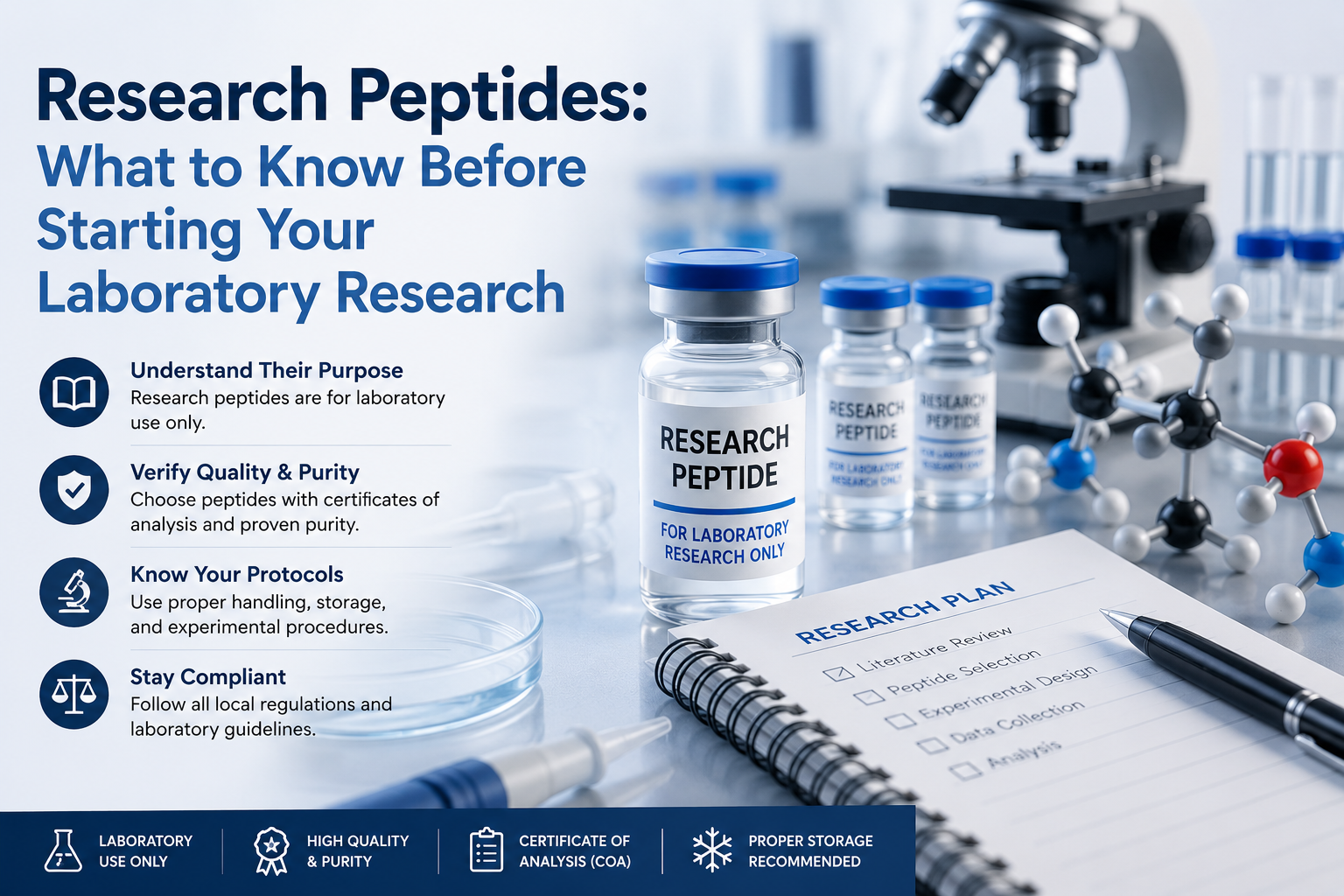
Research peptides have become valuable tools in modern laboratory science, helping researchers investigate biological pathways, molecular interactions, receptor activity, and other areas of experimental biology.
But with so many peptide compounds and suppliers available, selecting the right research material requires more than simply choosing a product from a catalog.
Researchers need to consider the compound’s characteristics, analytical documentation, purity, storage requirements, supplier transparency, and the specific objectives of their research.
In this guide, we’ll explore the key factors researchers should understand before purchasing research peptides and how to evaluate peptide products with greater confidence.
TL;DR: Research peptides should be evaluated based on identity, purity, analytical documentation, batch information, storage requirements, and supplier transparency. A clear research objective should come before selecting a specific compound. Primal Genix provides research-focused peptide products for laboratory and scientific applications.
For research use only. Not for human consumption.
Peptides are short chains of amino acids connected by peptide bonds. In biological systems, peptides can participate in signaling, receptor interactions, cellular communication, and numerous other processes.
In laboratory research, scientists can also work with synthetic peptides to investigate specific biological questions under controlled experimental conditions.
Research peptides may be designed to replicate naturally occurring sequences, represent modified peptide structures, or provide researchers with experimental compounds for investigating particular biological pathways.
Their applications can vary significantly depending on the peptide, research model, experimental design, and scientific objective.
This is why there is no single “best” research peptide.
The appropriate compound depends on what the researcher is trying to investigate.
Peptides provide researchers with relatively specific molecular tools for studying biological processes.
Depending on their structure and target, peptide compounds can be investigated in areas such as:
One of the advantages of peptide research is the ability to investigate individual molecular pathways in controlled laboratory environments.
Researchers can therefore use peptide compounds as experimental tools to help understand how particular biological systems behave.
However, results obtained from laboratory or preclinical research should not automatically be interpreted as evidence of human therapeutic effects.
One of the most important steps when selecting a research peptide is defining the research question first.
Instead of asking:
“Which peptide should I buy?”
start with:
“What biological process am I trying to study?”
This simple change can make the selection process much easier.
For example, a researcher may be interested in:
If the objective involves receptor activity, researchers may investigate peptides associated with specific receptor families or signaling pathways.
Researchers studying cellular behavior may focus on compounds relevant to particular cellular pathways or molecular interactions.
Certain peptide pathways are investigated in metabolic and endocrine research, providing experimental tools for studying signaling mechanisms.
Peptides can also be investigated in neuroscience-related studies involving receptor pharmacology, signaling, and molecular pathways.
Some experimental peptides are studied in relation to mitochondrial biology, cellular energy pathways, and membrane-related mechanisms.
The important point is that the research question should determine the compound—not the other way around.
Once you have identified the type of compound relevant to your research, the next step is evaluating product quality and documentation.
Here are several factors worth checking.
The first question should be simple:
Is the material actually the compound described by the supplier?
Identity testing can help confirm that the molecular characteristics of the supplied material correspond with the intended peptide.
Analytical techniques such as mass spectrometry may be used for this purpose.
Identity confirmation is especially important because purity alone does not establish that a sample is the correct compound.
Purity is another important consideration when evaluating research peptides.
Analytical techniques such as high-performance liquid chromatography (HPLC) can be used to assess the composition of a peptide sample.
Researchers should look for clearly documented analytical results rather than relying only on statements such as:
A transparent supplier should provide meaningful information supporting its quality claims.
The exact purity requirement can also depend on the research application and experimental methodology.
A Certificate of Analysis (COA) provides analytical information about a specific product or batch.
Depending on the supplier and testing process, a COA may include:
For researchers, batch-specific documentation can be particularly useful because it creates a connection between the material being supplied and the analytical results reported for that material.
Before purchasing a peptide, check whether relevant analytical documentation is available.
Imagine that a laboratory purchases the same peptide several times over a period of months.
If each purchase has clearly documented batch information, researchers can maintain better records of the materials used in different experiments.
This can be useful when:
Good documentation therefore contributes not only to purchasing decisions but also to better research organization.
Researchers often encounter both HPLC and mass spectrometry when reviewing peptide documentation.
Although they are different analytical techniques, they can provide complementary information.
HPLC can help evaluate the composition and chromatographic purity of a sample.
In simple terms, it helps researchers examine how much of the analyzed material corresponds to the expected peptide relative to other detectable components.
Mass spectrometry can be used to examine molecular mass and support peptide identity confirmation.
In simple terms:
HPLC helps evaluate purity.
Mass spectrometry helps evaluate identity.
Using multiple analytical approaches can provide a more complete picture of a research material than relying on a single measurement.
The terms research grade and pharmaceutical grade should not be treated as interchangeable.
Research-grade materials are intended for laboratory and scientific research applications and are not automatically suitable for clinical or therapeutic use.
Pharmaceutical products are subject to substantially different manufacturing, quality-control, regulatory, and documentation requirements.
For this reason, researchers should always pay attention to how a supplier labels its products and the intended-use information provided with the material.
A legitimate research supplier should clearly communicate that its products are intended for research purposes rather than presenting experimental compounds as approved medicines.
Choosing a peptide is only part of the process.
The supplier providing the material also deserves careful consideration.
Look for suppliers that clearly communicate product specifications, testing information, and intended use.
Transparency makes it easier for researchers to evaluate whether a product is appropriate for their work.
A detailed product page should ideally provide useful information about the compound rather than only a product name and purchase button.
Relevant information may include:
Research peptides should be clearly identified as research materials.
Suppliers should avoid misleading therapeutic claims or language suggesting that experimental compounds are approved for human use.
Researchers may have technical questions before placing an order.
A professional supplier should make it reasonably easy to obtain product-related information and clarification.
Clear and consistent information across product pages, documentation, packaging, and COAs can help researchers maintain accurate records.
Selecting a high-quality peptide is only the beginning.
Once a research material reaches the laboratory, appropriate storage and handling become important considerations.
Peptide stability can be influenced by factors such as:
Different peptide compounds may have different requirements, so researchers should always follow the specific storage and handling information supplied for the material.
Avoid assuming that every peptide can be stored under identical conditions.
Proper laboratory storage helps researchers protect the integrity of their research materials and maintain better experimental consistency.
At Primal Genix, our focus is on providing research-oriented peptide products for scientific and laboratory applications.
We understand that researchers need more than a product name.
They need clear information that helps them evaluate research materials before making a purchasing decision.
Our approach focuses on providing a research-focused catalog where customers can explore available peptide compounds and review the information associated with each product.
Whether you are beginning a new research project or sourcing materials for an ongoing laboratory program, choosing a supplier that emphasizes clarity and transparency can make the purchasing process easier.
Looking for research peptides for your next laboratory project?
Explore the Primal Genix peptide collection and review the available product information to identify materials relevant to your research requirements.
Primal Genix — Research Materials. Clear Information. Scientific Focus.
Before placing an order, use this simple checklist:
✓ Define your research objective
Know what biological pathway, mechanism, or research question you are investigating.
✓ Confirm the compound identity
Make sure the product is clearly identified and supported by appropriate analytical information.
✓ Review purity information
Look for documented analytical purity rather than relying solely on marketing claims.
✓ Check the COA
Review available batch-specific analytical documentation.
✓ Verify batch information
Make sure the material can be appropriately identified and recorded.
✓ Review storage requirements
Understand how the specific research material should be stored and handled.
✓ Check research-use labeling
Make sure the product is clearly intended for laboratory research.
✓ Evaluate supplier transparency
Choose suppliers that provide useful and accessible product information.
Research peptides are experimental compounds used in laboratory and scientific research to investigate biological pathways, molecular interactions, receptor activity, cellular processes, and other areas of experimental biology.
Their specific use depends on the peptide and the research model.
Start by reviewing compound identity, purity information, analytical testing, batch documentation, and the available Certificate of Analysis. Supplier transparency and clear product documentation are also important considerations.
A Certificate of Analysis is a document that provides analytical information about a particular product or batch. Depending on the supplier, it may contain purity, identity, batch, molecular weight, and testing information.
Purity can affect the reliability and interpretation of laboratory experiments. Researchers should therefore consider documented analytical results when evaluating a research peptide.
No. Research-grade materials are intended for scientific and laboratory research, while pharmaceutical-grade materials are subject to different manufacturing and regulatory requirements associated with pharmaceutical applications.
Storage requirements can vary between compounds. Researchers should follow the specific storage instructions provided for the peptide and consider factors such as temperature, moisture, light, and handling conditions.
Transparent suppliers make it easier for researchers to evaluate product information, analytical documentation, batch details, and intended use before purchasing research materials.
Selecting research peptides should be a structured process.
Start with the scientific question. Then evaluate the compound’s identity, purity, analytical documentation, batch information, storage requirements, and supplier transparency.
The best purchasing decision is not necessarily the product with the most impressive marketing description. It is the product for which researchers can obtain sufficient information to make an informed laboratory sourcing decision.
With a research-focused approach and clear product information, Primal Genix aims to make peptide sourcing more straightforward for researchers and scientific professionals.
Explore Primal Genix Research Peptides today and find the research materials relevant to your next project.
For research use only. Not for human consumption.
Products offered by Primal Genix are intended exclusively for laboratory and scientific research purposes. They are not intended for human or veterinary consumption, diagnosis, treatment, cure, or prevention of any disease.
No account yet?
Create an Account